
Journal of Environmental Education Research and
Sustainable Development
(JEERESD)

Publication Information

The Journal of Environmental Education Research and Sustainable Development
* Corresponding author.
NYETAM Benjamin, IMPM-MINRESI
P.O.BOX: 13033, Yaoundé-Cameroon.
Email: nyetambenjamin@gmail.com. CC : apeddecenvironnementcamer@gmail.com
Phone (237). 699 185 365 /652 629 603
DOI : 10.5281/zenodo.17237707
Reçu le 16 aout; révisé le 29 aout, Accepté 15 Septembre; publié le 30 septembre 25.
© 2025 The Authors. Published by EcoClean Environment Company. This is an open access article under the CC BY 4.0 license (http://creativecommons.org/licenses/CC BY 4.0/).
Published by EcoClean Environment Company
EFFECTIVENESS OF NEEM SEED EXTRACTS IN THE FIGHT AGAINST WEEVILS OF MAIZE IN STORAGE FOR SUSTAINABLE EATING PRACTICES
NYETAM Benjamin1,2,3*, DONGFAGSITELI. T. Néhémie2, TCHOKOUAHA Y. Lauve2, AMBANG Zachée1
1Laboratory of biotechnology and environment, University of Yaoundé 1.
2Centre for Research on Medicinal Plants and Traditional Medicine of the Institute of Medical Research and Medicinal Plants Studies (CRPMT- IMPM).
3Association for environmental protection, sustainable development and circular economy (APEDDEC-Cameroon)
Abstract
Context: Context: The invasion of maize pests (Sitophilus zea mays Motschulsky) in crops and storage areas causes enormous losses. To overcome this constraint, producers and owners of storage warehouses generally use synthetic insecticides. These are polluting, expensive and have harmful effects on the health of consumers and the environment. In the search for alternatives for healthy and sustainable eating practices, the objectives of this work were to evaluate the repellent capacity of Azadirachta indica seed oil extract on corn weevils in storage, its efficacy on maize weevils in storage, and the contact efficacy of seed powder extracts on maize weevils in storag. Methods: Phytochemical screening was carried out on the extracts obtained according to some known procedures. The effectiveness of Neem extracts was determined by repellency; contact toxicity tests were carried out according to the usual methods. Results: Phytochemical screening shows secondary metabolites such as terpenes, flavonoids, phenols, alkaloids, tannins, Anthraquinones, coumarins, Anthocyanins, terpenes, among which you can find the actives principles of A. indica, responsible of the insecticide activity of Neem extracts. Neem oil is repellent at 62.5 %. This allows us to categorize it in the class IV of repulsive substances. However, it’s moderately repellent during the first two hours and repellent after two hours. This oil was lethal against Sitophilus Zea mays, with 100 % mortality by contact at a dose of 400 µl, and a nearby result at 200 µl. Neem powder caused 100 % mortality from the third day, after the treatment at most of doses (LC50 = 94,62 µl, LC50 = 1,07 g in 24h). Conclusion: Our Neem extracts protect the production against weevils and avoids losses, ensuring food security.
I-INTRODUCTION
CONTEXT:
Goals number five and three of the African Union's Agenda 2063, recommend modern agriculture for increased productivity and production, good health and good nutrition for citizens also. They are in line with the second Sustainable Development Goal (SDG 2), which recommends ending hunger, ensuring food security, improving nutrition, and promoting sustainable development. According to Cameroon's national development strategy (SND30), in 2017, 16% of households suffered from food insecurity in urban areas and 22.2 % in rural areas (Anonymous 1, 2020). This situation is similar or much more alarming in others areas of the country or continent and is getting worse with the demographic boom. At a time when the importation of wheat and rice is experiencing problems due to the Russia-Ukraine war, independently of Africa. Maize which was already the most consumed cereal in Africa, is now proving to be an important solution to the food problem affecting the continent. Maize production, like other local crops, should therefore increase and be protected in quantity and quality. In fact, this production faces threats including insect pests such as corn stalk and ear borers, leaf insect pests of corn, and especially insect pests of corn in storage such as Maize weevils (Sitophilus Zea mays , Sitophilus oryzae) the greater maize borer, the beetles and the grain aluce (Sikirou et al, 2018). Damage caused by Sitophilus is estimated at around 20-25 % of field production, 15-20 % of post-harvest losses. Total losses would be estimated at 35 to 45 % of the food crop value chain in Cameroon. (IRAM & MINADER, 2017).
The fight against the pests mentioned above is done by traditional methods and technics including exposure to the sun, smoking, the use of repellent or insecticide plants such as pepper, the use of inert materials, some ashes, conservation in a confined atmosphere (Anonymous 3, 2018).
Publisher:
EcoClean Environment Company
Biological control uses antagonistic living organisms, predators of pests such as nematodes, arthropods, as well as parasitoids, corn borer, wasps sympiesis virudila, Macrocentrus cingulum), tachin fly Lydella thompsoni, Parasitoids of aphids, Wasps aphidin , etc. (Anonymous 2, 2014; Christine & Josée , 2009).
This fight against pests of crops and harvests is mainly done through synthetic insecticides, approved or not. Among them: organochlorines, whose active ingredients can be Dichloro-Diphenyl-trichloroethane (DDT) and other chlorinated derivatives; organophosphates, the active ingredients of which may be malathion, phosmet, pirimiphos-methyl, pirimiphos-ethyl, parathion-methyl, etc. ; carbamates having among others as active ingredients: bendiocarb, carbarl, methi ocarb, etc. insecticides from the pyrethroid family may have as active ingredients: acrinathrin, allethrin, bromethrin, etc. neonicotinoids include clothianidin, dinotefuran, imidacloprid, etc. (Anonymous 2, 2014). However, according to the World Health Organization (WHO), few years ago, synthetic pesticides are the cause of the death of 200,000 people each year around the world, and in Africa these risks are increased. The United Nations Environment Program (UNEP) also notes that in sub-Saharan Africa, the potential cost of treating diseases linked to pesticides between 2005 and 2009 was estimated at 6.3 billion; and that of 2005 and 2020 was estimated at 90 billion dollars (Aggrey, 2017; Anjarwalla et al, 2016). On August 26th 2024, all the Cameroonians’ medias have reported on a tragedy where six persons died after eating maize crops which had been treated with synthetic pesticides.
For a long time, there was no comprehensive scientific study aimed at beetle insects such as S. Zea mays. This is due to the fact that it is in tropical countries and particularly in Africa, where research was not developed that these insects are big threats, because the climate of western and rich countries is not favorable to them. Note, however, the studies by Tamgno & Ngamo (2014) who worked on the use of Neeem ( A. indica) as alternative to synthetic insecticides for the protection of maize and sorghum seeds in the logone valley. Diabate et al. (2020), worked on the toxicity of aqueous extracts of A. indica and Jatropha curcas on Plutella Xylostella by contact. Furthermore, the Ministries of Agriculture of certain West African countries such as Benin, have recommended the informal use of A. indica extracts to farmers as a Biopesticide (Sikirou et al., 2020). In Cameroon, there is almost no usable data on this subject. Our study provides additional scientific informations to that field. This will convince skeptics and provide assurance for the effective use of A. indica as a Bioinsecticide.
We face a double problem which is that of the invasion of insect pests of crops, and storage areas such as maize weevils, as well as damage to the health of consumers and the environment, due to synthetics pesticides or insecticides used in the fight against harmful organisms. The urgency of the development of natural insecticides or plant-based Bioinsecticides is signaled and proves to be a strategic element in the quest for large production, food security and environmental protection.
The question is to know how can we effectively control pests such as weevils which affect plants and stored foodstuffs such as maize, without polluting the environment or harming the health of consumers? And the research hypothesis we are working on is that: the toxic effects of Azadirachta indica (Neem)-based bio-insecticide extracts can effectively control corn weevils, while helping to reduce environmental pollution by replacing the synthetic insecticides used. So, our general objective is "to study the toxic effects of oil and powder extracts from the seeds of A. indica on S. Zea mays (Coleoptera: Curculionidae) of maize in storage. The specifics objectives were to evaluate the repellent capacity of Azadirachta indica seed oil extract on corn weevils in storage, its efficacy on maize weevils in storage, and the contact efficacy of seed powder extracts on maize weevils in storage
II-MATERIALS AND METHODS
II.1. Material
II.1.1. Study site
The main site of the study is the Center for Research on Medicinal Plants and Traditional Medicine of the Institute of Medical Research and Medicinal Plants studies (CRPMT-IMPM) of Ngoa-ékelle in Yaounde. Samples of A. indica were collected at Mokolo market in Yaoundé (Cameroon) and S. Zea mays at Mfoundi market. The manipulations at the CRPMT-IMPM were carried out in particular in the laboratory of botany and traditional medicine for the repulsion and contacts assays of the A. indica extracts on S. Zea mays and the laboratory of Galenics and Pharmaceutical Technology for the pressed oil sample. machine. The experiment was done in ambient average temperature of about 25 ° C.
II.1.2. Biological material.
The animal material used was S. Zea mays, and the plant material, included A. indica s and Zea mays seeds (figure 1). Samples of S. zea mays which are of the genus Sitophilus, of the order of Coleoptera and of the family of Curculionidae were collected at the Mfoundi market in Yaoundé, in untreated maize waste (stalks, bran), infested and sorted before the sale.
The shelled kernels and seeds of A. indica A. juss, were purchased at the Mokolo market in Yaoundé, from the northern part of Cameroon.
The North Cameroon white maize seeds used were purchased at the Mfoundi market in Yaoundé.

Figure 1: Biological Material A1&A2: Seeds and Kernels of Azadirachta indica; B: Sitophilus Zeamais (Scale: 5); C: Maize in storage.
II.1.3. Equipment and others.
Equipment used:
The manual crushing machine, the manual winepress machine, 1-liter glass jars, venti-line brand oven, syringes, filter paper, petri dishes, glass jars, gangs, sampling tubes, sensitive balance, camera, cotton, acetone, etc.
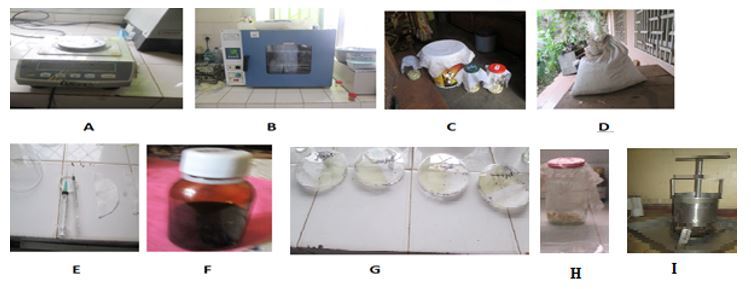
Figure 2. Equipment. A: sensitive equilibrium; B: Oven; C et D: Sitophilus zeamais rearing device; E: syringes; F: Neem oil; G: petri dishes; H: glass jar; I: oil press
II.2. Methods
This study is an experimental study, carried out in the laboratories mention above.
II.2.1. Collection and breeding of corn weevils.
The samples of S. zeamais were collected from a maize seller's store at the Mfoundi market in Yaoundé. They were collected with cob debris and maize bran containing a few handfuls of seeds, in a bag (Nyetam, 2022). Subsequently, they were transposed into a bucket covered with a transparent fabric, then into glass jars, as they approached use. Breeding was therefore done in mass.
II.2.2. Choice and packaging of the maize variety.
The variety chosen is white maize from North Cameroon (large and small grains) found in our markets, for breeding and experimentation. Before the experiment, we stored our seeds in clean glass jars. They were put in the refrigerator three days before the experiment in order to kill the germs, then removed and dried (Boeke et al., 2001).
II.2.3. Preparation of Azadirachta indica seed extracts.
The almonds previously dried at ambient temperature are put in an oven at 60 °C, during twelve hours. A quantity of 843 g of A. indica seed almond powder is obtained after molding 860 g of dried seed almonds using a manual mill, shortly before the extraction process and shortly before the various necessary tests requiring the powder (Nyetam, 2022).
800 g of crushed A. indica seed powder are introduced into a makeshift cylindrical press with a grid and cotton at its base, then pressed so as to drop its oil into a container placed below.
Efficiency (% ) =(Mass of extract (g) Mass of plant material (g) X100
II.2.4. Effectiveness of A. indica seed extracts on weevils.
The repulsion test or extract avoidance test is used to determine whether weevils, given the choice, are able to detect the extract from A. indica seeds and sidestep it.
The repellency assay is used to calculate the percent repellency of seed oil on corn weevils by the preferential zone method described by Mc Donald et al. (1970). Indeed, the discs of whatman filter paper n° 2 of 9 cm in diameter were divided into two equal parts of 31.79 cm2 of surface (Fig. 3). Four concentrations were prepared by dilution in 0.5 ml acetone, of the following seed oil volumes: 100, 200, 300 and 400 µl. The solutions thus obtained were homogenized by manual stirring and produced on one half of the disc (using an insulin syringe). The other half, treated only with 0.5 ml of acetone, served as a control. Ten minutes were then allowed to elapse, the time for the solvent to evaporate completely. The following oil concentrations were thus obtained (volume/area): 3.14 µl/cm2, 6.29 µl /cm2, 9.43 µl /cm2 and 12.58 µl /cm2. The filter paper discs were reconstituted depending on the treated halves and the control halves using clear adhesive tape and placed in petri dishes (fig.3). Fifteen adult weevils, just taken from their rearing medium, were placed in the center of each paper, and the petri dishes covered. Four replicates were performed for each oil concentration. The counting of weevils on each half of the disc was carried out after 1 hour, 2 hours, 3 hours and 4 hours, of treatment under laboratory conditions. The percentage repellency is calculated according to the formula used by Nerio et al. (2009) as follows:
PR(%) =Nac- Nh(Nac+Nh)X100
PR= Percentage of repulsion
Nac= number of weevils present on the half-disc treated with acetone.
Nh= number of weevils present on the half-disc treated with the dose of oil.

Figure 3 : Repellency test.
Average repellency percentage is calculated and assigned to the different repellent classes according to the classification of Mc Donald et al (1970), represented by the following Table I:
Table I. Repellent classes according to the classification of Mc Donald et al (1970).
Repellent classes
Repulsion intervals (%)
Properties
Class 0
< 0,1
Not repellent
Class I
0,1-20
Very weak repellent
Class II
20,1-40
Weakly repellent
Class III
40,1-60
Moderately repellent
Class IV
60,1-80
Repellent
Class V
80,1-100
Very repellent
Mc Donald et al., 1970.
Volumes of 100, 200, 300, 400 µl of A. indica oil are prepared by dilution with 1ml of acetone and mixed with 30 g of corn contained in 1000 ml glass jars. The whole was homogenized by manual stirring and left for 5 to 10 minutes for complete evaporation of the solvent. The respective concentrations of 3.33; 6.66; 9.99 and 13.33 µl/g were obtained. Then, 15 adult insects were introduced into each jar, and the latter was covered with porous fabric held in place with elastic ties. The control dishes were prepared under the same conditions and treated only with acetone (1ml). Four tests of 15, 15, 10, 10, insects, are carried out per dose and for the control, the results expressed for an average of 25 insects. The jars are stored under ambient conditions in the laboratory.
Fifteen adult maize weevils are introduced into transparent polystyrene jars containing 30 g of white maize seeds. These are treated with different doses of A. indica seed powder.
Four doses of A. indica seed powder (1, 5, 10, 15 g) are used for 30 g of maize seeds; i.e. 3.33 respectively; 16.67; 33.33 and 50 % of the weight of the seeds, control batches (0%) are carried out in parallel with untreated seeds. Four repetitions are carried out for all the doses and for the control. The jars are stored under ambient conditions in the laboratory.
Dead insects were counted every 24 hours during a period of the experiment. The mortality rate was assessed through the ratio of the number of dead insects to the number of insects initially introduced according to the following formula.
MR(%)=NCMNCIX100
With, MR (%): Mortality rate; NCM: number of dead weevils; NCI: number of weevils introduced.
Mortality was calculated and corrected according to Abbott's formula taking into account natural mortality (Mt) observed on the control (Abott, 1925, cit. Ambela minkeng, 2018).
Mc=Mo-Mt100-Mtx100
Mc: corrected mortality; M0: mortality of the sample tested; Mt: mortality in the untreated control.
And the LD50 or CL50 of Neem oil and powder were estimated according to the time of exposure of the insects to the different doses, using the smallest dose whose mortality rate is closer to 50 % with the rule of three or by plotting a standard curve giving the variations in mortality as a function of the increasing concentrations of the products.
II.2.5. Statistical analysis of data
Data were measured or calculated for each response variable at the test level (percentages of mortality, repellency, etc.). The raw data were visually explored to check for consistency, entered into MS-Excel, and then statistically analyzed according to the Mc Donald et al. (1970) classification. For these statistical analysis, computer software called graph pad Prism and Excel were used.
III. RESULTS
III.1. Extraction Yield.
With 860 g of dried almonds, we obtained 843 g of powder, i.e. a yield of 98.02 % and by introducing 800 g to the press, we had 56.5 g of oil, with a concentration of 1.3 g/ ml, i.e. a yield of 7.06 %, and a quantity of approximately 44 ml of A. indica oil. This yield is lower than what would have been obtained by solvent extraction, but the raw and natural character of the extract obtained could have advantages in activity and is easily assimilated to the oil extracts used by the farmers (Table II).
Table II. Extraction Yield
Excerpt name
Masses of plant material
Mass of the extract obtained
Yield
Powder
860g (almonds)
843 g
98,02 %
Pressed oil
800g (Powder)
56,5 g
7,06 %
III.2. Effectiveness of A. indica seed extracts on weevils.
-Depending on doses
At the dose of 200 µl (6.29 µl/cm2), the difference in the rate of repulsion is significant with the other doses; Neem oil is very repellent at 200 µl, while it is moderately repellent at doses of 100 µl (3.14 µl/cm2), 300 µl (9.43 µl/cm2), 400 µl (12.58 µl/cm2). Because, we note that at 300 µl and 400 µl, its effect is no longer only repellent, but also lethal or paralyzing. the insects which venture into the part of the disc treated with A. indica oil, are paralyzed, unable to flee and thus find death. The overall repellency average is 62.25 %(Tables III).
Table III. Repellent effect of oil extracts from A. indica seeds on weevils depending on amounts
The amount of oil
Number of individuals
Average percent repellency
Effect
repellency class
In the untreated part (Nac)
in the treated part(Nh)
100µl (3,14µl/cm2)
80
20
60 %
Moderately repulsive
III
200µl (6,29µl/cm2)
94
6
88 %
very repulsive
V
300µl (9,43µl/cm2)
77
23
54 %
Moderately repulsive (but kills)
III
400µl (12,58µl/cm2)
74
26
48 %
Moderately repulsive(but kills°
III
-Depending on duration
No matter the concentration, the Neem oil is repellent toward S. zeamais after 2 hours, and Moderately repulsive during the first two hours (Table III). A. indica oil is Repulsive of class IV (Table IV).
Table IV. Repellent effect of oil extracts from A. indica seeds on weevils depending on durations.
Duration
Average percent repellency
Repellency class
Effect
Azadirachta indica oil
1h
56
III
Moderately repulsive
2h
56
III
Moderately repulsive
3h
64
IV
Repulsive
4h
74
IV
Repulsive
Mean
62,5±8,54
IV
Repulsive
The contact of maize treated with different doses of A. indica oil, with S. Zea mays [Coleoptera: Curculionidae], shows that the mortality rate increases with the duration of contact and reaches its maximum on the 4th day for the 100 µl dose. From the 1st day, mortality reaches 100% at the dose of 400 μl and approaches this maximum for the doses of 200 μl and 300 μl, because there is no significant difference between their mortality rates, from the 1st to the 4th. day. The effectiveness of the 300 µl dose does not increase on the 2nd and 3rd day, compared to the 200 µl dose which proves to be slightly more effective during this period and compared to the 400µl dose, the effectiveness of which is maximum from the first 24 hours. The DL50 or CL50 decreases when the exposure time increases, and varies from 94.62 µl during o1 day to 55.11 µl when 4 days are needed to kill fifty percent of Sitophilus zeamais (Table V&VI).
Table V. Contact toxic effects of Azadirachta indica seed oil on maize weevils
Duration
Corrected number of deaths and cumulative mortality rate as a function of dose and time
0 µl
100 µl
200 µl
300 µl
400 µl
1g Sinograin
Deaths
Rate
Deaths
Rate
Deaths
Rate
Deaths
Rate
Deaths
Rate
24h
2
13,21
52,84%
21,42
85,68%
21,42
85,68%
23,46
93,84%
23,46
93,84%
48h
2
20,40
81,6%
22,44
89,76%
21,42
85,68%
23,46
93,84%
23,46
93,84%
72h
2
21,42
85,68%
22,44
89,76%
21,42
85,68%
23,46
93,84%
23,46
93,84%
96h
3
22,68
90,72%
22,68
90,72%
22,68
90,72%
22,68
90,72%
22,68
90,72%
MOY
2,25
±0,5
19,62
±4,46
77,71%
±0,16
22,24
±0,56
88,98%
±0,02
21,73
±0,63
86,94%
±0,02
23,52
±0,12
93,06%
±0,01
23,52
±0,12
93,06%
±0,01

Figure 3: Corrected number of deaths as a function of dose and time
Table VI. LC50 of Neem Oil as function of time
24 h
48 h
72 h
96 h
DL50 ou CL50
3,15 µl/g
2,05 µl/g
1,9 µl/g
1,83 µl/g

Figure 4: LC50 of Neem oil as function of time
The contact of maize treated with different doses of A. indica powder, with S. Zea maïs [Coleoptera: Curculionidae], shows that the mortality rate increases with the duration of contact and reaches its maximum (100 %) on the 3rd day for the dose of 5 g, 10 g and 15 g. however, the 5g dose proves to be the most effective on day 1 (93.33 % versus 46.66 %, 80 % and 86.66 %, respectively for 1 g, 10 g and 15 g). the LC50 varies from 1.07 g (35,66 g/kg) for 1 day to 0.53 g(17,66 g/kg) for 2, 3 or 4 days. The 5 g (166,66 g/kg) dose is the LC100.
Table VII. Contact toxic effects of Azadirachta indica seed powder on maize weevils
Duration
Corrected number of deaths and cumulative mortality rate as a function of dose and time
0g
1g
5g
10g
15g
1g Sinograin
M
1M
MR
M
MR
M
MR
M
MR
M
MR
24h
7
46,66%
14
93,33%
12
80%
13
86,66%
15
100%
48h
14
93,33%
14
93,33%
12
80%
13
86,66%
15
100%
72h
14
93,33%
15
100%
15
100%
15
100%
15
100%
96h
14
93,33%
15
100%
15
100%
15
100%
15
100%
Table VIII. LC50 of Neem powder as function of time.
24 h
48 h
72 h
96 h
DL50 ou CL50
35,66 g/kg
17,66 g/kg
17,66 g/kg
17,66 g/kg

Figure 5: LC50 of Neem powder as function of time
DISCUSSION
The toxic effects of A. indica-based bio-insecticide extracts can effectively control corn weevils, while helping to control environmental pollution, and reducing consumer’s diseases due to the use of synthetic insecticides. And this experiment was conducted by using the scientific usual methods presented above.
The yield of mechanical extraction of Neem oil is 7.06 %, which is much lower than the yields by solvents such as hexane, methanol and water which had 25.5 %, 12.5 % and 60 % respectively (Nyetam, 2022). However, the pure nature of this extract, which has not been subjected to any mixture of solvents, as well as the observed effectiveness, leaves no doubt about our results. The repellent toxicity tests of A; indica oil extracts made on S. zea mays showed repellent properties at all doses with an average of 62.5% corresponding to Mc Donald's class IV (Ndomo et al., 2009), with a lethal or paralyzing effect that takes over the repellent properties at doses of 300 µl and 400 µl at the slightest contact with the oil. To kill 50 % of maize weevils (LC50) within 24 hours, we need more Neem oil than within 48, 72, or 96 hours (decreasing quantity). The same thing tends to happen with the LC50 of Neem power only during the first 48 hours. The LC50 of the Neem powder after 72 or 96 hours of contact exposition tends to remain the same as that of 48 hours of exposition. These scientific data bring more precisions to Cameroonian or African users, who were using it informally until now.
Contact toxicity tests revealed insecticidal properties of the oil, ranging up to 90.72 % on the 4th day regardless of the dose. That mortality goes to 90.72 % from the first day for 400 µl (13,33µl/g), after applying mortality corrected by Abbott (1925), which takes into account the deaths observed in the control. However, since the oil extract is almost totally deadly from the first day, it can be assumed that insects that died of natural death would not have lasted more than two or three days in contact with the oil anyway. In that case the oil is 100 % lethal on the 4th day, for the smallest dose. From the first day the doses of 200 µl, 300 µl record a minimum mortality rate of 92 %, while at 400 µl the oil is 100% lethal on the 1st day. The powder extract, the control of which had no deaths, had a mortality of 93.33 % at doses of 1g and 5g, from the 2nd day, while the doses of 10 g and 15 g still only had 80 % and 86.66 % dead. From the 3rd day, the doses of 5 g, 10 g, and 15 g reach 100 %. According to Nyetam (2022), chemical insecticide call kill 50 % of the lab mousses within 3 hours of exposition by the respiratory way, while Neem seeds extracts have no negative effect by that same way. So, Neem seeds extracts sustainable and efficient solution.
On the other hand, according to Faye (2010), Debelmas and Hache tested the effect of the aqueous extract of neem on the central nervous system in 1976; No significant anticonvulsant, anticholinergic, analgesic, or sedative effects were observed. However, anti-stress effects, which would have been beneficial for our rats and mice, thus confirming the benefits that could be derived from a bio-insecticide based on Neem, compared to a synthetic insecticide, were observed, which reinforces our idea that Sinograin (chemical insecticide) has more negative impacts on health than A. indica (Nyetam, 2022). Our study comes in a context where Cameroonian and Africans farmers apart from some of them, do not know the use of Neem as an insecticide or pesticide, they do not have scientific data on the insecticidal virtues of Neem, do not master the dosages or dreads its bitterness. But illnesses and deaths (200,000 deaths/year), and the expenses caused by the synthetics pesticides, published by WHO and UNEP show us the dangers to which people are exposed (Anjarwalla, 2016). Our study is in line with the third and fifth goals of 2063 agenda, as well as the second sustainable development goal.
LIMITATIONS
The Neem seeds extracts have an embittered taste and a heavy smell that prevent from consuming directly the seeds that have been protected by our Bioinsecticide. Anyway, it may not cause bad effects on consumers’ health such as chemical insecticides use to do. Another weakness is the unavailability of Azadirachta indica’s seeds.
This study will be completed with the study of others effect of Neem seeds extracts such as antifungal effects and also formulation of one or two Biopesticids. The bad smell and bitter taste will be removed by relevant phytopharmaceuticals and food technology methods.
CONCLUSION
At the end of this study, we have carried out repellent tests which showed the repellent properties of Azadirachta indica, making it possible to classify it in Mc Donald's class IV. The contact toxicity testing of Azadirachta indica oil has proven that it can achieve 100 % mortality, from day one at 400 µl (13.33 µl/g), and at all doses on day four for 30 g of corn. At doses of 200 µl and 300 µl, the mortality rate approaches 100 % from the first and second day. The mortality rate of the powder extract by contact is also close to 100 %, from 5 g. In 24 hours, the average lethal concentrations 50, are 94.62 µl (3.15 µl/g or 3.15 ml/kg) for oil and 1.07 g (35.66 g/kg) for Azadirachta indica powder.
The double problem of the destruction of maize stocks in storage and that of damage to the health of its consumers, due to synthetic insecticides, therefore finds a natural and reliable solution with the advantage of having a more positive than negative impact on the health. Many farmers in west Africa have starting using Neem seeds extracts to protect their crops. In this study, our producers will therefore, find the scientific proof and data allowing them to now use Azadirachta indica extracts with complete peace of mind. This study brings the food security and sustainable eating practice that have been lost with the use of synthetic insecticides that cause more than 200 000 deaths per year. It will equally contribute to avoid crops losses, improve earnings and fight against hunger.
ACKNOWLEDGEMENT
Special thanks to the general Director of IMPM, the chief of CRPMT, the department of physiology and plant biology of the university of Yaounde 1, and all my colleagues in CRPMT-IMPM for their multiple support during this study.
Conflicts of interest
The authors declare no conflict of interest.
List of authors and their contributions
NYETAM Benjamin is the main author of this part of the work which is from his Memories, he almost did all the work (study conception and design, experiments, data analysis, interpretation, manuscript writing, etc.) Professor AMBANG Zachee was the supervisor (study conception and design, data analysis, critical revision and approval). Dr DONFAGSITELLI T. Nehemie and Dr TCHOKOUAHA YAMTHE Lauve have also review it ( data analysis, manuscript critical revision).
Financial contribution
NYETAM Benjamin is the only provider of funds that have been used in this work and have never been reimbursed.
REFERENCES
A. de Jussieu, (1988)., Azadirachta indica, Wood and forest review of the tropics (No. 217): P 33-46.
Aggrey A., (2017). Tackling pesticide exposure in sub-saharian Africa: a story from Uganda. Outlook on pest management (37/41): p 61-64.
Anjarwalla P., Belmain S., Sola P., Jamnadass R., Stevenson P. C., (2016). Guide to pesticidal plants. World Agroforestry Center (ICRAF), Nairobi, Kenya, 63 p.
Anonymous1, (2020). National Strategy for Development 2020-2030. Ministry of Economy, Planning and Regional Development - United Nations Development Programme. ISBN: 978-9956-26-085-0. 231 p (p21, 39, 43, 44, 48.).
Anonymous 2, (2014)., phytosanitary index of Cameroon, MINADER, pp. 80-103.
Anonymous 3, (2018). Pest Management Plan under the National Participatory Development Program-Phase “3” and additional funding ida18. PNDP. 83p.
Boeke S.J., Van Loom J.J.A., Van Huis A., Kossou D.K., Dicke M., (2001). The use of plant meterial to protect stored leguminous against seed beatles: a view. Backhuys publishers, Wageningen, 108p.
Christine J and Josée B., (2009). Pests and beneficial insects of sweet corn: knowing them better. Institute for research and development in agro-environment inc (IRDA), Quebec, 92p.
Diabate D., Kadio E. A. A. B., Tano Y., (2020). Toxicité des extraits aqueux de Azadirachta indica
a. juss et de Jatropha curcas l. sur Plutella xylostella (l.) (lepidoptera : plutellidae) par contact. Agronomie Africaine 32 (4) : 489 - 498
Faye M., (2010). Nouveau procédé de fractionnement de la graine de Neem (Azadirachta indica a.jussi) sénégalais : production d'un bio-pesticide d'huile et de tourteau. PhD, National Polytechnic Institute of Toulouse. 267 p.
IRAM and MINADER., (2017). Evaluation of agricultural risks in Cameroon. Platform for Agricultural Risk Management. Managing risks to improve farmers' livelihoods. Cameroon, 138 P.
Issoufou Y., Djibo A. K & Idrissa M., (2019). Phytochemical characterization and larvicidal activity of crude plant extracts from the Traditional Pharmacopoeia of Niger on Anopheles gambiae S.L. Euro larvae. sci. journal, vol 15; (No. 12 ISSN.1857-7881): 30-51.
Jean Beigbeder, (2013). Maize from Mexico to the Pyrenees. interview. p 1-23.
Kossou D.K., Bosque-Perez. N.A., (1992). Pests of stored corn: biology and control methods. Iita Research Guide (No. 32), Training Curriculum. International Institute of Tropical Agriculture (Iita), Ibadan, Nigeria. 23p.
Mc Donald L.L., Guy R.H. & Speirs R.D., (1970). Preliminary evaluation of new candidate materials as toxicants, reppellents and attractants against store products insects. Marketing research report, United States department of Agriculture, No. 882. Washington, 183 p.
Ndomo A.F et al., (2009). Evaluation of the insecticidal properties of leaves of Callistemon viminalis (Myrtaceae) against adults of Acanthoscelides obtectus (Say) (Coleoptera; Bruchidae). Tropicultura, 27: 137-143
Nerio L.S., Olivero-verbel J. & Stashenko E. (2009). Repellency activity of essential oils from seven aromatic plants grown in Colombia against Motschulsky (coleoptera). Journal of stored product research 45:2012-2014;
Nyetam B., (2022). Study of the toxic effects of Azadirachta indica A juss seed extracts on Sitophilus zeamais and their impact on the health of consumers. Master, University of Yaoundé 1, 80 p.
Schmutterer, H., (eds.), The Neem Tree, Azadirachta indica A. Juss and other Meliaceous Plants. VCH: Weinheim (1995).
Sikirou R., Nakouzi S., Adanguidi J., Bahama J., (2020). Technical manual for the protection of maize in cultivation and storage in Benin, Food and Agriculture Organization of the United Nations and the National Institute of Agricultural Research of Benin, Cotonou, 96 p.
Sikirou R., Nakouzi S., Adanguidi J., Bahama J., (2018). Recognition of maize pests in storage in Benin and control methods. Fact sheet, Food and Agriculture Organization of the United Nations and the National Institute of Agricultural Research of Benin, Cotonou, 32p.
Sikirou, R., Nakouzi S., Adanguidi, J. and Bahama J., (2018). Recognition of maize pests in cultivation in Benin and control methods − Technical sheet. Cotonou, FAO. 28pp.
Tahouo S F., (2016). Global Phytochemical Compound Extraction Procedures for the Analytical Evaluation of Herbal Medicines. State Diploma of Doctor of Pharmacy, N°1757/16, Félix Houphouet Boigny University, 119 p.
Tamgno B. R., Ngamo Tinkeu S.L., (2014). Utilisation des produits dérivés du neem Azadirachta
indica A. Juss comme alternatifs aux insecticides synthétiques pour la protection des semences de maïs et de sorgho dans la Vallée du Logone. Sci tech develop, volume 15, (1029 – 2225) : 1-8.
LC50
:
Lethal mean Concentration killing 50 % of the population.
CRPMT
:
Center for Research on Medicinal Plants and Traditional Medicine.
DDT
:
Dichloro-Diphényl-Trichloréthane.
LD50
:
Lethal mean Dose killing 50 % of the population.
FAO
:
Food and Agricultural Organisation of the United Nations.
IMPM
:
Institute of Medical Research and Medicinal Plants studies
IRAD
:
Institut de Recherches Agricoles pour le Développement (Institute of Agricultural research for development).
IRAM
:
Institut de Recherches et d’Applications des Méthodes de Développement (Institute for research and application of development methods).
IRDA
:
Institut de recherche et de développement en agroenvironnement(Institute for reseach and development in Agro-Environment).
MINADER
:
Ministry of Agriculture and rural development.
MINEPAT
Ministère de l’économie, de la planification et de l’aménagement du territoire
Mc
:
Corrected mortality.
MR(%)
Mortality rate
OECD
Organisation for economic cooperation and development.
SDG
:
Sustainable development goals.
PR
:
Percentage of repulsion.
SND30
:
National development Strategy 2020-2030.
UNEP
United Nations Environment Program.





Contacts
Cameroon
Address: EcoClean Environment Company Ministry of Research P.O. Box 13033 Yaoundé, Cameroon Tel: +237 671 139 503 Fax: +237 671 13 95 03 Email: jeeresd@jeeresd.online
Nigeria
Address: EcoClean Environment Company University of Ibadan, Ibadan, Nigeria Tel: +234 803 456 7890 Fax: +234 803 456 7891 Email: jeeresd@jeeresd.online
Sudan
Address: EcoClean Environment Company University of Khartoum, Khartoum, Sudan Tel: +249 912 345 678 Fax: +249 912 345 679 Email: jeeresd@jeeresd.online
Tunisia
Address: EcoClean Environment Company University of Tunis P.O. Box 1234 Tunis, Tunisia Tel: +216 71 123 456 Fax: +216 71 123 457 Email: jeeresd@jeeresd.online
Subcribe to our news letter





EcoClean Environment © Company
2026
Texte court 3 pour le template